Wednesday, April 24, 2013

Field Experience Questions

1. How many hours did you complete?
·   5 hours

2. In a short paragraph or bulleted list, how did you spend your time?
·   Observing lessons
·   Teaching a lesson
·   Helping students
·   Helping a small reading group

3. How did the experience help you to strengthen at least one Kentucky Teacher Standard? (be sure to name the standard)
·   The experience helped me strengthen Standard 7: The teacher reflects on and evaluates teaching and learning.  I am used to reflecting on lessons to see how they go or what I would do differently, but by using the KTIP format I was able to really reflect in-depth on what I taught.  It required me to go back and see how many students were able to meet, go above, or fell below criteria.  I was able to give the teacher exactly which students did not master the content based on my teach.

4. Talk a little about one thing you learned because of this field experience.
·         I learned that there are many different ways to teach something. I noticed the teacher I was with taught time in a different way than I ever have.  She used a number line and was able to show the students how to do elapsed time. I have never seen that before and I was amazed how she did it. I have already showed my team and we are planning on using the strategy next year with our students.

Reading Log


Reading Log for 25 books (to paste into your blog in at the end of the term)


Genre / Titles you read (Hit enter after each one and a new number should pop up)

             I.      Non-fiction/Informational (1 chapter book or photo essay book reflection required on blog)

1)      Heaven is for Real by Todd Burpo (blog)

2)      The Planets in our Solar System by Franklyn Branley (not on blog)

3)      The Magic School Bus: Lost in the Solar System by Joanna Cole (not on blog)

4)      The Magic School Bus Chapter Book #4: Space Explorers by Joanna Cole (not on blog)


          II.      Poetry (1 chapter or picture book reflection required on blog)

1)      Hate that Cat by Sharon Creech. (blog)

2)      Dogku by Andrew Clements (wiki)

3)      My Favorite Poetry for Children by Caroline Kennedy (not on blog)


       III.      Modern Fantasy (1 chapter book reflection required on blog)          

1)      I, Jack  by Patricia Finney. (required for discussion – do NOT use on blog)

2)      The Hunger Games by Suzanne Collins (blog)


       IV.      Historical Fiction (1 reflection required on blog –can be a picture book)     

1)      The Teacher’s Funeral by Richard Peck. (required for discussion – do NOT use on blog)

2)      Baseball Saved Us by Ken Mochizuki (blog)


          V.      Multicultural/Traditional (2 reflections required on blog – one can be a picture book)         

1)      Hiroshima: A Novella by Laurence Yep (required for discussion – do NOT use on blog)

2)      In the Beginning told by Virginia Hamilton (blog)

3)      Dave the Potter by Laban Carrick Hill (blog)


       VI.      Realistic Fiction (1 chapter book reflection required on blog)

1)      Baby by Patricia MacLachlan. (required for discussion – do NOT use on blog)

2)      Holes by Louis Sachar (blog)


    VII.      Picture Books (5 reflections required on blog during the first two weeks of class. There should be a total here of at least six.)

1)      The Wednesday Surprise by Eve Bunting. (required for discussion – do NOT use on blog)

2)      Unspoken by Henry Cole (blog)

3)      The Rainbow Club by Annette Aubrey (blog)

4)      Diary of a Fly by Doreen Cronin  (blog)

5)      Born Yesterday: The Diary of a Young Journalist by James Solheim  (blog)

6)      Fly Away Home by Eve Bunting  (blog)

7)      The Wall by Eve Bunting (not on blog)

8)      Breakout at the Bug Lab by Ruth Horowitz (not on blog)

9)      Ivy and Bean by Annie Barrows (not on blog)


Wiki Checklist

Instructions: Write the number of entries for each category you posted into on the Course Wiki


_1__ Social Studies

____ Science

____ Math

____ Music

____ Art

_1__ Reading/Language Arts

____ Physical Education

____ Other

Heaven is for Real by Todd Burpo

Burpo, T., & Vincent, L. (2010). Heaven is for real: A little boy's astounding story of his trip to heaven and back. Nashville, Tenn: Thomas Nelson.

Todd Burpo tells the story in first-person point of view. He is telling the story from his point of view, but telling the readers using Colton's words.

Colton Burpo was three years old when he told his parents he had a stomach ache.  They went to the doctor and his stomach ache was misdiagnosed as the flu. He ends up having to be rushed to the hospital because of his stomach and they realize that his appendix has burst causing it to poison his body.

 Colton's dad is the author of the book and he goes into details of what Colton tells them about his near death experience, except that he never died.  They have no records of Colton's heart stopping, but he was able to tell about his experience in Heaven.  This book goes through what he says about Heaven and compares it to the Bible.

I believe this book would be for older children at the high school level.  It conveys truths that younger students might not understand. For instance, he talks about an upcoming battle with Satan.

This is a great book that I would recommend to anyone!


Sunday, April 21, 2013

Baseball Saved Us by Ken Mochizuki

Mochizuki, K., & Lee, D. (2004). Baseball saved us. Pine Plains, N.Y.: Lee & Low Books Inc.

Have you ever felt left out or different?  I bet you have at one point.

This book Baseball Saved Us is about a little boy that feels left out because he was different.  During World War II his family and other Japanese families were sent to a camp in the middle of a desert. They had to stay behind wire fences and couldn't get out until the war ended. 

This is a great story about a boy that goes through things that many kids your age never go through.  If you would like to see what happens to him when he goes back home you should check this book out at the library.

Sunday, April 14, 2013

Holes by Louis Sachar

Sachar, L. (1998). Holes. New York: Farrar, Straus and Giroux.

Stanley Yelnats was given a choice. The judge said, "You may go to jail, or you may go to Camp Green Lake." Stanley was from a poor family. He had never been to camp before.

Have you ever been accused of something you haven't done?  I bet that's most of you! I have a story for you!

Stanley Yelnats is a boy that was accused of taking something that wasn't his.  He didn't really take them though.  Through these unfortunate events, he got in trouble and had to decide whether he wanted to go to jail or to camp.  He didn't really blame the judge or anyone blaming him.  He is used to being blamed for things and having misfortune because of his "no-good-dirty-rotten-pig-stealing-great-great-grandfather." Stanley didn't know what he was getting himself into when he decided to go to camp, because this wasn't just any camp!  This was Camp Green Lake. 

At Camp Green Lake the boys were supposed to be "building character" by digging holes-five foot deep and five foot wide-everyday!  It doesn't take long for Stanley to make some friends.  After a few days of camp Stanley starts to figure out that there are other things going on at Camp Green Lake, that involve the warden.  Stanley goes out on an adventure to find out why the boys are really digging holes.

This is a book that I really enjoy reading and I recommend it to my students every year.  Our librarian has it in stock if any of you would like to go and check it out to see if Stanley ever uncovers the truth about Camp Green Lake.

Friday, March 29, 2013

Hate that Cat by Sharon Creech

Creech, S. (2008). Hate that cat. New York: HarperCollins Publishers.

Hate that Cat is written from the point of view of Jack, a boy in Miss Stretchberry's class.  The novel is written in poetry from Jack's point of view. He is writing in his journal.  There are no chapters in this novel, only dates, for entries that Jack has written.

The novel starts off with Jack hating a black mean cat.  He goes through many similes and metaphors that show just how much he hates cats. I hate that cat, like a dog hates a rat.

Jack moves on throughout the year continuing to write entries in his journal.  He talks about how his teacher makes him use alliteration and onomatopoeia in his poetry and how he just doesn't like it very much. He uses examples of alliteration in his poetry to please his teacher, such as: purple pick, polished pencil, and chocolate chalk. Jack also states that onomatopoeia cause him to have frizzling ears, but he uses them to make his teacher happy. pop, buzz, drip, tinkle, trickle.

Throughout the story, Jack is struggling with hating cats in general.  He then gets a surprise for Christmas that year! A kitten! He starts to like the kitten even though he hates that big black fat cat that clawed him.  He has a couple of more battles with the big black fat cat and turns out to have a different perspective of him at the end of the book.

I read this to my students as I was reading it and they loved it! They immediately wanted to go to the library to check it out! (That's what happens when my students like books that I read. They like to go check it out and reread it themselves.) I told them about Creech's other book Love that Dog and they make the connection that it must be about Sky, Jack's dog that he mentions throughout the book.  We are waiting for it to be returned now so we can read it.

Dave the Potter by Laban Carrick Hill

Hill, L. C., & Collier, B. (2010). Dave the potter: Artist, poet, slave. New York: Little, Brown.

Dave the Potter is about a slave growing up two-hundred years ago.  He was a great artist, poet, and potter.   The book tells about the life that Dave lives as a slave, which is very different compared to other slaves.

Dave makes pots for his owners. The book goes through the steps of him making a pot. It mentions in the book that it is a mystery where he has learned to be a potter.    He would often leave the pots blank because he feared he would get in trouble if they caught him writing on them.

But sometimes, he would write a poem or the date on a pot he made.  At the end of the book, it shows Dave using a stick to write a poem on his pot.


I wonder where is all my relation
friendship to all- and, every nation
-August 16, 1857
 
The words in this book flow without having to be re-read, and are written in poem form in the middle of the page.
 
"The jar grew so large
Dave could no longer
wrap his strong arms around it.
If he climbed into the jar
and curled into a ball,
he would have been embraced."
 
This is one of the lines from a page in the book.  The author uses simple sentences so that the reader can understand how he makes his pots.
 
 
The author also uses a lot of similes so that the reader can understand exactly what Dave does and how it works.  My favorite simile in this book is where the author is comparing him shaping the pot to a magician.
 
"Like a magician
pulling a rabbit out of a hat,
Dave's hands, buried
in the mound mud,
pulled out the shape of a jar."
 
This book will help readers understand that slaves did more than just work out in the fields for their owners and that they were actual people.  This book is written with a lot of emotion and makes the reader relate to Dave, even though he lived in a different time and under different circumstances.


In the Beginning told by Virginia Hamilton

Hamilton, V., & Moser, B. (1988). In the beginning: Creation stories from around the world. San Diego: Harcourt Brace Jovanovich.

In the Beginning is a collection of 25 myths that tell how the world was created.    The myths are about gods, superhuman beings, animals, plants, and about the first people on the earth.  The myths tell about the events that cause changes in the way humans feel and act.

These stories are told from different places around the world, from Eskimo myths to Blackfoot American Indian myths.  These myths engage the readers and get them intrigued about what is going on during that time. It is often hard to understand some of the wonder that they are describing because it is a place that we will never see.

I believe that this is a Newbery Honor winner because of the many different stories and how engaged the book keeps its readers.  These narratives convey truth to the people that believe in them and the cultures that they come from.

One of my favorite creation stories from this book is The Pea-Pod Man: Raven the Creator. This myth is about a man that lay still in a pea-pod.  On the fifth day he pushed his legs out and hatched from the pea-pod. He ran into the Raven that created the vine he was from.  The Raven went on to create a mate, woman.  Then he went away and the woman and man created children and the world prospered.

If I used this in my classroom, I would have my students choose two creation stories and read them with a partner. I would then have them compare and contrast the creation stories to tell how they are alike and different.

Sunday, March 24, 2013

The Hunger Games by Suzanne Collins

Collins, S. (2009). The hunger games. London: Scholastic.

File:Hunger games.jpgThe Hunger Games is a fantasy chapter book that is for young adults. I would not use this book in my classroom because some of the themes and concepts would be too high for my students.  Some of the themes in this book are: poverty, the aftermath of war, and torture for enjoyment.

This book set in the future and is written from Katiniss Everdean's point of view.  She is a 16 year old girl that lives in District 12. Each year they have something called the Hunger Games, which is where tributes from each of the 12 districts come and fight to the death.  Katniss ends up in the Hunger Games because she takes her sister's place.  She has to prepare with help from a team from the Capitol.  Katniss is in a love triangle with Peeta, the other tribute from District 12, and Gale, her childhood friend.  She tries to figure out which one she loves, but doesn't really decide by the end of the book.  Peeta and her help each other throughout the games and end up as the last two.  The game makers say there can only be one winner.

If you have seen the movie then you should definately read the book!  

This is not my typical book, but I have seen the movie and wanted to see how the book compared.

For the most part, the movie followed the events of the book.  The book however, used imagery that the movie could just not duplicate.  For instance, in the end of the book when Peeta and Katniss are on top of the cornucopia and there are creatures that are mutations from the fallen tributes.  Collins goes into great detail about how they look and resemble the tributes.  The movie did not even include this imagery.  The movie just simply had creatures trying to attack Peeta and Katniss.

I am looking forward to reading the second and third book in this trilogy.

Sunday, March 17, 2013

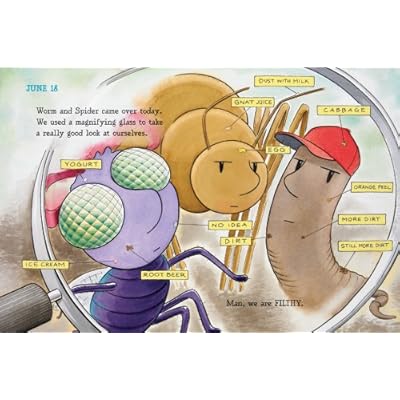
Diary of a Fly

Cronin, D., & Bliss, H. (2013). Diary of a fly. London: HarperCollins Children's.

This is another book that is in diary format that I want to use with my students next year.  There are similaries and differences to Born Yesterday: The Diary of a Young Journalist. 

Both books display the date the same way, at the top of the page, and they are both told from first person point of view.  This book however, has bigger illustrations that fill the page.  There is more labeling in the illustrations since it is told from the fly's point of view.  All of the illustrations are "bigger." What I mean is since a fly is very small, all of the illustrations seem huge.  There is a coke can on one page and it fills most of the page.  If you saw a coke can in the other book, it wouldn't take up so much space.

Cronin does a great job writing from the fly's point of view.  It goes into detail about how he is scared he will be the only one that eats regurgitated food at school and how he learns about the food chain from his friend, the spider. All Fly wants to be is a superhero and through his journey his friends help him realize that he can be anything.

This is a good book that I plan on using next year with my students during our writing units. I think when I go back to the library I am going to check out Diary of a Worm and Diary of a Spider. :)

Born Yesterday: The Diary of a Young Journalist

Solheim, J., & James, S. (2010). Born yesterday: The diary of a young journalist. New York, NY: Philomel Books.

Born Yesterday is a diary written in a first person point of view.  The baby is writing the diary beginning with the day she was born.

The diary shares funny thoughts that only a baby can have.  Whether it be her trying to hit the "thingy hanging over the crib," or trying to get into Kindergarten, she has a unique perspective on life. Throughout the book she keeps refering to her older sister. Once she figures out what "growing" is, she tries to grow and be like her sister.  She thinks her older sister is a super-chick that knows everything!

This is a funny story that goes through all of the first impressions of the big world to a baby.  I chose this book because one of our writing units have the students writing a diary from someone/something else's point of view.  I thought that this is a great example to use next year for them to see a different perspective from a baby.

Friday, March 15, 2013

Fly Away Home by Eve Bunting

Bunting, E., & Himler, R. (1991). Fly away home. New York: Clarion Books.

After reading The Wednesday Surprise, I wanted to find more books by Eve Bunting.  One of the ones I picked up was Fly Away Home.

Fly Away Home is about a little boy and his father. They live in an airport because they are not able to pay rent or a house payment.  It is told from the little boy's point of view.  "Do not get noticed!" He goes through all the "rules" of living in an airport. He and his father have to sleep sitting up.  "Do not get noticed!" They have to switch air terminals every night.  "Do not get noticed!" They wash up in the bathrooms.  "Do not get noticed!"  There is a repeated word/phrase throughout the book which is, "do not get noticed!"

The little boy sees many people, or friends, of theirs that get noticed because they are doing certain things.  He knows and makes his audience aware that he is very mature for a four/five year old.  He knows what he can do and cannot do while living at the airport.

The boy sees a bird one day that gets stuck in the airport.  The bird's underlying significance represents freedom, and the boy sees that.  Every time he gets sad about living in the airport, he thinks of the bird and how it took it awhile to get out, but eventually it was free.

The illustrations in this book were done by Ronald Himler.  His use of illustrations compliment the text.  When the little boy is describing a lady that got "taken away," he described her with a long, dirty coat pushing a cart.  The picture on the opposite page showed just that.  Himler uses changing colors to depict different moods of the little boy.  On the page where he is upset because he doesn't think he is special it is really hard, cool and dark colors.  Then it moves to bright and cheerful when he remembers the bird and knows that one day he will be free.

Sunday, March 10, 2013

The Rainbow Club by Annette Aubrey

Aubrey, A. (2007). The Rainbow Club. California: QEB Publishing.

Another theme I was going for this week was a picture book about bullying. I teacher third graders and they can be mean sometimes.  It is never a HUGE problem, but it can get in the way of their learning.  I was on a search to find one I could read to them and revisit "social skills."  

The Rainbow Club is not my favorite book ever, but I think it will help get the point across to them.  They love picture books!  I would put this book in a smaller age range.  I would say Kindergarten-1st grade.

The book starts with two children, Tommy and Chloe, who decide to wear only green the next day on their field trip.  When they show up the next day they are only nice to the other kids that are wearing green. They tell everyone they are in the "green club."  They are mean to all the students wearing blue and any other color.  The students wearing other colors are upset and embarrassed. 

The other students find anything they can to make themselves "green."  From the pictures, you can tell they put leaves in their hair and they find green ribbons.  Finally, one of the other students steps out and tells everyone that it is not what they are wearing, but what is on the inside.  She tells them that they it is all nonsense and that they should all be nice to each other.  The "green club" realizes this is true and they decide to come up with a new name.  They come up with The Rainbow Club.  All students can be in the Rainbow Club because they can wear any color.

The book has great illustrations by Patrice Barton.  They are colorful and inviting for students to look at.  The pictures match the words on every page as the story was told. 

I give this book three stars!!!

Unspoken by Henry Cole

Cole, H. (1955). Unspoken. New York: Scholastic Press.


When I was picking out picture books at the library I was in search of some that I could use in my classroom this coming week.  One of the books I was going after was a wordless book.  I love using wordless books in my room when we do lessons on illustrations giving us information.  I picked up the book Unspoken by Henry Cole.

This book is about a little girl that discovers a runaway slave in her family's barn.  She doesn't tell anyone about the stranger being there. The illustrations show her struggle in deciding what to do. Should she tell her parents (and the men that are looking) or should she do what is right and keep quiet to help the man.

Henry Cole uses graphite illustrations in the double spread picture book.  The illustrations create a suspenseful story that will keep my students interested throughout.  They fill the entire pages from corner to corner and keep the reader engaged. 

I give this book five stars!!!

Tuesday, March 5, 2013

Meet The Teacher!

Hello! My name is Cari Hamlin!

(The cute fellow next to me is my son, Mason!)

I teach a bunch of crazyyyyy third graders! I love my job!  I went from teaching a self-contained classroom to teaching Reading all day all of our third graders.  It is a HUGE difference going from teaching 24 kiddos to teaching 75 kiddos each day. 

My kiddos call our room "The Bee Hive" because I have bees EVERYWHERE! Do I like bees you ask? NO! I am actually allergic to bees.

Where did the name come from you ask? One of my college professors at the University of Kentucky would not let us pass her course (or graduate) until we gave her the name of our future classroom.  The only thing I could think of at the time was Hamlin's Honeybees.  So the bees stuck! 

And now I tell the kiddos that third grade is the place to BEE! :) Ha ha!