Showing posts with label Picture Books. Show all posts

Sunday, March 17, 2013

Diary of a Fly

Cronin, D., & Bliss, H. (2013). Diary of a fly. London: HarperCollins Children's.

This is another book that is in diary format that I want to use with my students next year.  There are similaries and differences to Born Yesterday: The Diary of a Young Journalist. 

Both books display the date the same way, at the top of the page, and they are both told from first person point of view.  This book however, has bigger illustrations that fill the page.  There is more labeling in the illustrations since it is told from the fly's point of view.  All of the illustrations are "bigger." What I mean is since a fly is very small, all of the illustrations seem huge.  There is a coke can on one page and it fills most of the page.  If you saw a coke can in the other book, it wouldn't take up so much space.
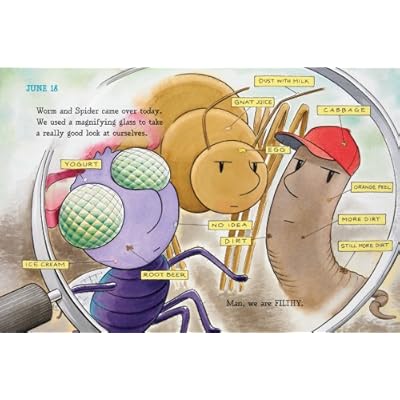
Cronin does a great job writing from the fly's point of view.  It goes into detail about how he is scared he will be the only one that eats regurgitated food at school and how he learns about the food chain from his friend, the spider. All Fly wants to be is a superhero and through his journey his friends help him realize that he can be anything.

This is a good book that I plan on using next year with my students during our writing units. I think when I go back to the library I am going to check out Diary of a Worm and Diary of a Spider. :)

Born Yesterday: The Diary of a Young Journalist

Solheim, J., & James, S. (2010). Born yesterday: The diary of a young journalist. New York, NY: Philomel Books.

Born Yesterday is a diary written in a first person point of view.  The baby is writing the diary beginning with the day she was born.

The diary shares funny thoughts that only a baby can have.  Whether it be her trying to hit the "thingy hanging over the crib," or trying to get into Kindergarten, she has a unique perspective on life. Throughout the book she keeps refering to her older sister. Once she figures out what "growing" is, she tries to grow and be like her sister.  She thinks her older sister is a super-chick that knows everything!

This is a funny story that goes through all of the first impressions of the big world to a baby.  I chose this book because one of our writing units have the students writing a diary from someone/something else's point of view.  I thought that this is a great example to use next year for them to see a different perspective from a baby.

Friday, March 15, 2013

Fly Away Home by Eve Bunting

Bunting, E., & Himler, R. (1991). Fly away home. New York: Clarion Books.

After reading The Wednesday Surprise, I wanted to find more books by Eve Bunting.  One of the ones I picked up was Fly Away Home.

Fly Away Home is about a little boy and his father. They live in an airport because they are not able to pay rent or a house payment.  It is told from the little boy's point of view.  "Do not get noticed!" He goes through all the "rules" of living in an airport. He and his father have to sleep sitting up.  "Do not get noticed!" They have to switch air terminals every night.  "Do not get noticed!" They wash up in the bathrooms.  "Do not get noticed!"  There is a repeated word/phrase throughout the book which is, "do not get noticed!"

The little boy sees many people, or friends, of theirs that get noticed because they are doing certain things.  He knows and makes his audience aware that he is very mature for a four/five year old.  He knows what he can do and cannot do while living at the airport.

The boy sees a bird one day that gets stuck in the airport.  The bird's underlying significance represents freedom, and the boy sees that.  Every time he gets sad about living in the airport, he thinks of the bird and how it took it awhile to get out, but eventually it was free.

The illustrations in this book were done by Ronald Himler.  His use of illustrations compliment the text.  When the little boy is describing a lady that got "taken away," he described her with a long, dirty coat pushing a cart.  The picture on the opposite page showed just that.  Himler uses changing colors to depict different moods of the little boy.  On the page where he is upset because he doesn't think he is special it is really hard, cool and dark colors.  Then it moves to bright and cheerful when he remembers the bird and knows that one day he will be free.

Sunday, March 10, 2013

The Rainbow Club by Annette Aubrey

Aubrey, A. (2007). The Rainbow Club. California: QEB Publishing.

Another theme I was going for this week was a picture book about bullying. I teacher third graders and they can be mean sometimes.  It is never a HUGE problem, but it can get in the way of their learning.  I was on a search to find one I could read to them and revisit "social skills."  

The Rainbow Club is not my favorite book ever, but I think it will help get the point across to them.  They love picture books!  I would put this book in a smaller age range.  I would say Kindergarten-1st grade.

The book starts with two children, Tommy and Chloe, who decide to wear only green the next day on their field trip.  When they show up the next day they are only nice to the other kids that are wearing green. They tell everyone they are in the "green club."  They are mean to all the students wearing blue and any other color.  The students wearing other colors are upset and embarrassed. 

The other students find anything they can to make themselves "green."  From the pictures, you can tell they put leaves in their hair and they find green ribbons.  Finally, one of the other students steps out and tells everyone that it is not what they are wearing, but what is on the inside.  She tells them that they it is all nonsense and that they should all be nice to each other.  The "green club" realizes this is true and they decide to come up with a new name.  They come up with The Rainbow Club.  All students can be in the Rainbow Club because they can wear any color.

The book has great illustrations by Patrice Barton.  They are colorful and inviting for students to look at.  The pictures match the words on every page as the story was told. 

I give this book three stars!!!

Unspoken by Henry Cole

Cole, H. (1955). Unspoken. New York: Scholastic Press.


When I was picking out picture books at the library I was in search of some that I could use in my classroom this coming week.  One of the books I was going after was a wordless book.  I love using wordless books in my room when we do lessons on illustrations giving us information.  I picked up the book Unspoken by Henry Cole.

This book is about a little girl that discovers a runaway slave in her family's barn.  She doesn't tell anyone about the stranger being there. The illustrations show her struggle in deciding what to do. Should she tell her parents (and the men that are looking) or should she do what is right and keep quiet to help the man.

Henry Cole uses graphite illustrations in the double spread picture book.  The illustrations create a suspenseful story that will keep my students interested throughout.  They fill the entire pages from corner to corner and keep the reader engaged. 

I give this book five stars!!!